
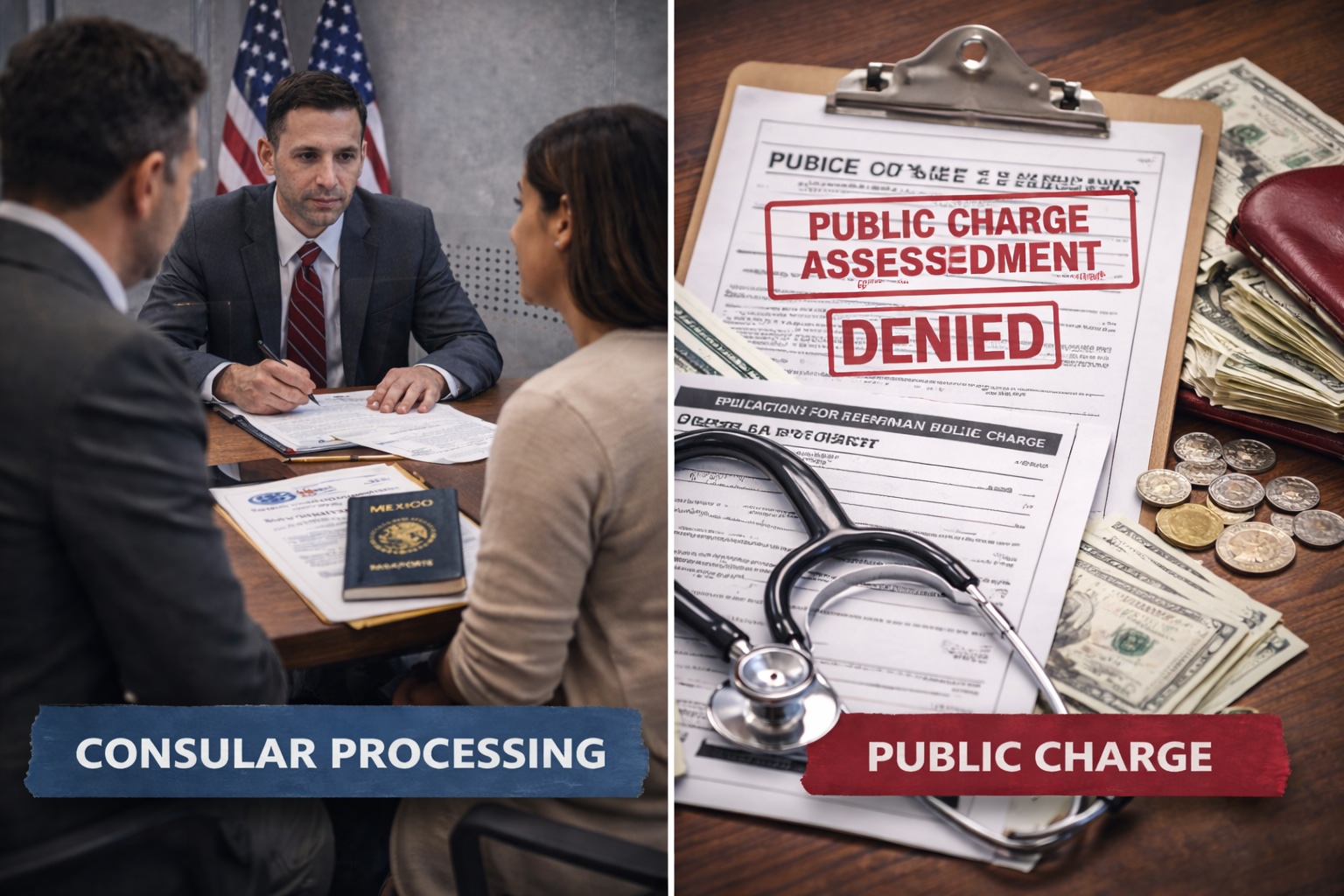
Consular Processing and Public Charge Law Under the Trump Administration: What Immigrants Should Know
Immigrants applying for a green card through consular processing must meet several legal requirements before receiving an immigrant visa.
One of the most important issues that may affect applicants is the public charge rule.
During the Trump administration, the public charge policy received significant attention and changes.
Although some rules have evolved over time, understanding how the public charge law works in consular processing cases remains critical for immigrants applying for visas abroad.
This article explains what the public charge rule is, how it affects consular processing,
and what applicants should expect in 2026.
What Is the Public Charge Rule?
Under U.S. immigration law, a person may be considered
inadmissible as a public charge
if the government believes they are likely to become primarily dependent on public benefits in the future.
This rule applies to many immigrants seeking:
- Immigrant visas through consular processing
- Adjustment of status inside the United States
- Certain nonimmigrant visas
Consular officers and immigration officials evaluate whether an applicant is likely to rely on government assistance.
The Public Charge Rule During the Trump Administration
The Trump administration expanded the interpretation of the public charge rule,
placing greater emphasis on an applicant’s financial situation and ability to support themselves.
Immigration officers were instructed to evaluate several factors, including:
- Income and financial resources
- Employment history
- Education and skills
- Health and medical conditions
- Family support
- Age
The rule also increased scrutiny of individuals who had previously used certain public benefits.
Although legal challenges and policy changes followed,
the concept of financial self-sufficiency remains an important factor in immigration cases.
How Public Charge Affects Consular Processing
When someone applies for a green card through consular processing,
the U.S. consulate must determine whether the applicant is admissible to the United States.
One of the main documents used in this analysis is the
Affidavit of Support (Form I-864).
The Affidavit of Support requires a sponsor, usually a family member,
to demonstrate that they have sufficient income to financially support the immigrant.
The sponsor must generally show income at or above 125% of the federal poverty guidelines.
If the sponsor does not meet the requirement,
a joint sponsor may be used.
Documents Used to Evaluate Public Charge
Consular officers typically review several documents to determine whether the applicant may become a public charge.
These may include:
- Form I-864 Affidavit of Support
- Tax returns of the sponsor
- Proof of employment
- Bank statements or financial records
- Evidence of assets
- Proof of education or employment history
Proper documentation is essential to demonstrate that the applicant will not depend on public benefits in the United States.
Common Issues That Can Lead to Public Charge Concerns
While most family-based immigration cases meet the financial requirements,
certain issues may trigger additional scrutiny.
Examples include:
- Sponsors with income below required levels
- Incomplete financial documentation
- Lack of employment history
- Medical conditions without proof of insurance or support
If these concerns arise, the consulate may issue a
221(g) refusal requesting additional documentation
before making a final decision.
Preparing for a Consular Interview
Applicants should carefully prepare for their consular interview
to avoid delays related to public charge concerns.
Important preparation steps include:
- Ensuring the Affidavit of Support is properly completed
- Bringing recent tax returns and financial evidence
- Confirming that the sponsor meets income requirements
- Providing documentation showing the applicant’s work history or skills
Proper preparation can help reduce the risk of delays or requests for additional evidence.
How an Immigration Attorney Can Help
Consular processing cases can involve complex legal issues,
particularly when financial eligibility or public charge concerns arise.
An immigration attorney can help by:
- Reviewing the Affidavit of Support and financial documentation
- Identifying potential public charge concerns before the interview
- Preparing the applicant for the consular interview
- Responding to requests for additional evidence from the consulate
Proper legal guidance can help ensure that the case proceeds as smoothly as possible.
Immigration Help With Consular Processing
Applying for a green card through consular processing requires careful preparation and documentation.
At Gonzalez Legal, P.C., we assist clients with:
- Family-based immigrant visas
- Consular processing cases
- Waivers of inadmissibility
- Immigration interview preparation
Our office represents clients throughout Massachusetts,
including Boston, Lynn, and surrounding communities,
as well as individuals completing consular processing abroad.
📞 Contact Gonzalez Legal, P.C. today to schedule a consultation
and discuss your immigration case.
Frequently Asked Questions
What is the public charge rule in immigration?
The public charge rule allows immigration officials to deny visas or green cards
if they believe an applicant is likely to rely primarily on government assistance.
Does public charge apply to consular processing cases?
Yes. Consular officers evaluate whether applicants may become a public charge before issuing immigrant visas.
What is the Affidavit of Support?
The Affidavit of Support (Form I-864) is a document where a sponsor agrees to financially support the immigrant and demonstrate sufficient income.
Can a joint sponsor help if the petitioner does not meet income requirements?
Yes. A joint sponsor can submit an additional Affidavit of Support if the main petitioner does not meet the financial threshold.

Emmanuel Gonzalez, Esq.
Latest Posts
 by Emmanuel Gonzalez, Esq.
¿Le Negaron una Visa de Inmigrante por Carga Pública? Un Nuevo Bono Podría Ser una Opción
El Departamento de Estado está utilizando un programa piloto de bonos de carga pública en determinados casos de visa de inmigrante, pero los solicitantes...
by Emmanuel Gonzalez, Esq.Denied an Immigrant Visa for Public Charge? A New Bond May Be an Option
The State Department is using a public-charge bond pilot program in selected immigrant-visa cases, but applicants cannot simply choose to post a bond on...