
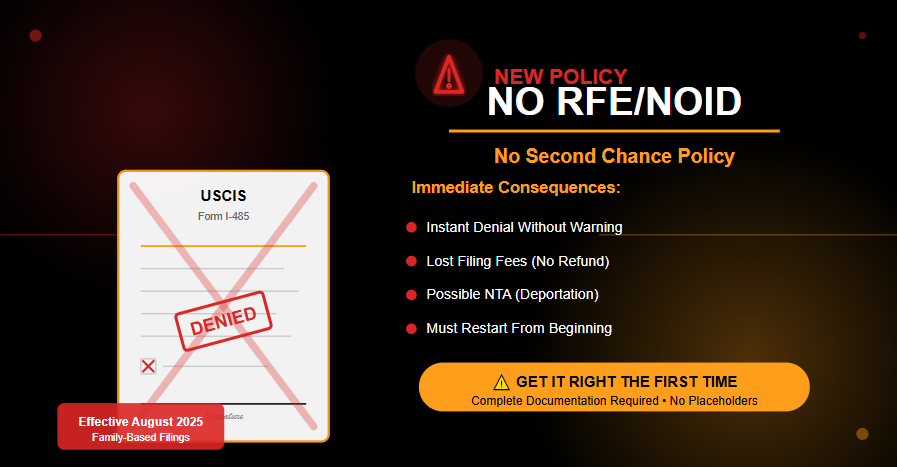
USCIS’s “No RFE/NOID” Policy: Why You Must Get Your Petition Right the First Time
If you are applying for a Green Card, work visa, or any other immigration benefit, a small mistake on your application used to result in a second chance. Now, that second chance is disappearing.
U.S. Citizenship and Immigration Services (USCIS) has doubled down on a policy that allows adjudicators to deny petitions outright without first sending a Request for Evidence (RFE) or a Notice of Intent to Deny (NOID).
This policy shift creates a high-stakes environment where one missed document or a minor error can lead to an immediate denial, loss of filing fees, and, for some, a direct referral to deportation proceedings.
- The Death of the “Second Chance”
In the past, USCIS policy leaned toward helping applicants correct simple errors.
- Request for Evidence (RFE): Sent when the officer needed more proof (e.g., a missing birth certificate, more proof of a marriage, etc.). It gave you a generous deadline to respond.
- Notice of Intent to Deny (NOID): Sent when the officer was ready to deny the case but wanted to give you one last chance to rebut specific negative information.
The New Reality (Effective August 2025 for Family Filings):
USCIS has affirmed that if your application is filed without all the required initial evidence, or if the evidence you submit clearly does not establish eligibility, the officer has full discretion to deny the case immediately.
This means:
- No Warning: You may not receive an RFE or NOID. Your first notification could be a final denial letter.
- Wasted Money and Time: A denial means you lose your filing fees (often hundreds or thousands of dollars) and must start the long process over from the beginning.
- The Greatest Risk: The NTA (Notice to Appear)
The consequences of a denial are highest for those already living in the U.S. without a final legal status, particularly those adjusting status (filing for a Green Card from inside the U.S.).
Under current enforcement policy, if your application is denied and you are found to be unlawfully present, USCIS may issue a Notice to Appear (NTA), the first step in placing you into formal deportation (removal) proceedings.
This means an honest mistake on your application can literally put you on the path to being removed from the country.
- High-Risk Documents: Your Pre-Filing Checklist
To protect your petition, you must treat your initial filing like your only chance. Pay extra attention to the following common areas where officers are denying cases without warning:
| Risk Category | High-Risk Mistake | How to Get It Right |
|---|---|---|
| Forms & Signatures | Using an old version of a form; Missing the signature on any required form (including the sponsor’s affidavit). | Always download forms directly from the USCIS website on the day you file. Ensure all required forms are included and signed in the correct spot. |
| Legal Status/Entry | Failing to include a copy of the I-94 Arrival/Departure Record or providing an I-94 with an incorrect status. | Print your I-94 online to ensure you submit the correct, most recent record showing your last lawful entry. |
| Financial Support | Submitting the I-864 Affidavit of Support with an income that is under the Federal Poverty Guidelines, or missing the most recent tax documents. | Double-check your household size and income against the poverty guidelines. Include all required tax returns, W-2s, and pay stubs for the sponsor. |
| Foreign Documents | Sending a foreign document (like a birth or marriage certificate) without a proper English translation. | Every single document not in English must have a certified translation attached, including a translator’s signed statement certifying their competence. |
| Relationship Proof | For marriage-based cases, sending only one utility bill or a few photos. | Front-load the evidence. Submit joint documents (leases, bank accounts, insurance) showing cohabitation and financial commingling over time. |
The Final Rule: Never File a “Placeholder”
This policy is USCIS’s warning to stop filing “placeholder” or incomplete applications hoping to submit the full evidence later.
To keep your filing safe and your fees intact, you need a single, complete, and perfectly organized petition that leaves no doubt about your eligibility. If you are unsure whether your case is strong enough, seek the guidance of an immigration attorney immediately.

Gonzalez Legal P.C.
Latest Posts
 by Gonzalez Legal P.C.
Why Are Asylum Applications Getting Harder to Get Approved? Understanding the Rising Bar
For many people fleeing violence, persecution, and danger, asylum in the United States represents safety and hope. However, in recent years, asylum...
by Gonzalez Legal P.C.¿Por Qué Cada Vez Es Más Difícil Que Se Aprueben las Solicitudes de Asilo? Comprendiendo el Aumento de Requisitos
Para muchas personas que huyen de la violencia, la persecución y el peligro, el asilo en Estados Unidos representa seguridad y esperanza. Sin embargo, en...