
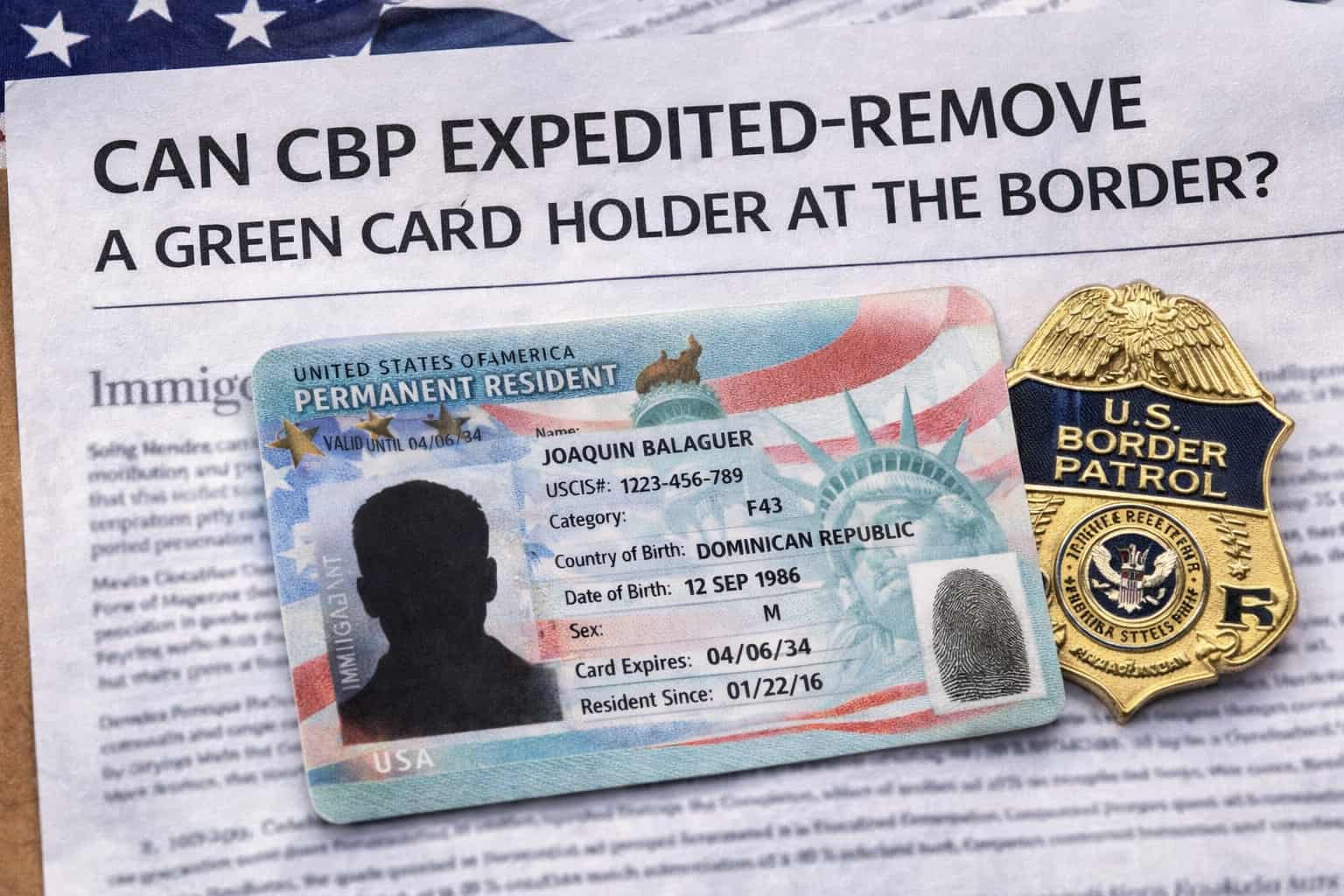
Why a CBP Officer May Decide You Abandoned Your Green Card: Protecting Your LPR Status
Lawful Permanent Residents (green-card holders) are allowed to travel outside the United States. However, re-entry is not automatic, and at the border, a Customs and Border Protection (CBP) officer may question whether you intended to abandon your permanent resident status.
Many green-card holders are shocked to learn that abandonment is not based on a single factor, such as trip length alone. Instead, CBP looks at your intent, and intent is inferred from your actions, documents, and life choices.
Understanding how CBP evaluates abandonment can help prevent serious immigration consequences.
What “Abandonment” Really Means
Abandonment does not require you to formally give up your green card.
CBP may find abandonment if it believes:
- You no longer intended the U.S. to be your permanent home, or
- You made another country your primary residence
This determination is discretionary and often made during secondary inspection, sometimes within minutes.
Common Reasons CBP Concludes You Intended to Abandon Your Green Card
1. Long or Repeated Absences from the U.S.
Time outside the U.S. is the most common trigger.
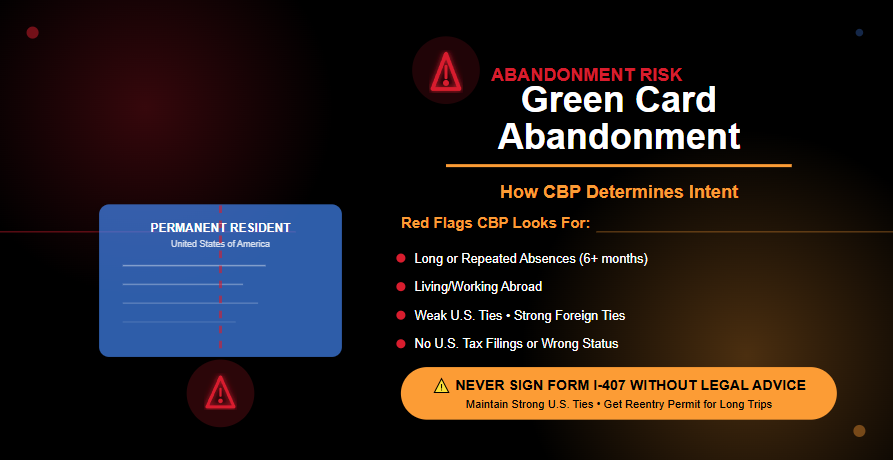
Red flags include:
- A single absence of more than 6 months
- Any absence of more than 12 months without a reentry permit
- Repeated long trips where the U.S. appears to be only a place you “visit”
⚠️ Even trips under 6 months can raise concerns if they happen frequently.
2. Living or Working Abroad
CBP may conclude abandonment if you:
- Took a job abroad
- Operated a business overseas
- Attended school abroad long-term
- Held a long-term lease or owned a residence outside the U.S.
Employment abroad is one of the strongest indicators of abandonment unless clearly temporary.
3. Weak Ties to the United States
CBP looks at where your real life is centered.
Risk factors include:
- No U.S. home or lease
- No U.S. job or active business
- No U.S. tax filings as a resident
- No immediate family in the U.S.
- Minimal time physically present in the U.S.
Strong foreign ties combined with weak U.S. ties often lead CBP to question intent.
4. Strong Ties to Another Country
Even if you have some U.S. ties, abandonment may be inferred if you:
- Own or maintain a primary home abroad
- Have a spouse or children living abroad
- Maintain foreign bank accounts or businesses
- Use a foreign address consistently
CBP compares U.S. ties vs. foreign ties, and whichever is stronger often controls the outcome.
5. Statements Made at the Border
What you say matters, and casual answers can be damaging.
Problematic statements include:
- “I live in [another country] now.”
- “I’m just visiting the U.S.”
- “I moved back home during COVID.”
- “I’m not sure when I’ll return.”
Even honest but poorly worded answers can be interpreted as abandonment.
6. Failure to File U.S. Taxes as a Resident
Filing taxes incorrectly can be devastating.
Red flags:
- Filing as a nonresident
- Not filing U.S. taxes at all
- Claiming foreign residency for tax purposes
Tax filings are often used as objective evidence of intent.
7. No Reentry Permit for Extended Travel
A reentry permit does not guarantee admission, but not having one during extended absences can seriously hurt your case.
CBP often asks:
- Why didn’t you apply for a reentry permit?
- Did you intend to live abroad indefinitely?
What CBP Cannot Use Alone to Prove Abandonment
CBP cannot lawfully find abandonment based solely on:
- ❌ An expired green card
- ❌ A brief trip abroad
- ❌ Pending I-751 or extension letters
- ❌ Marital problems
- ❌ Lack of English proficiency
Abandonment requires totality-of-the-circumstances analysis, not a single factor.
What Happens If CBP Believes You Abandoned Your Green Card?
If CBP believes abandonment occurred, they may:
- Ask you to sign Form I-407 (Record of Abandonment)
- Refer you to secondary inspection
- Attempt to place you into removal proceedings
- In some cases, improperly attempt expedited removal
⚠️ NEVER sign Form I-407 without understanding the consequences.
Signing it is a voluntary surrender of your green card.
How to Protect Yourself
Before Traveling:
✅ Maintain strong U.S. ties
✅ File U.S. taxes as a resident
✅ Limit time abroad
✅ Obtain a reentry permit if travel will be extended
✅ Carry proof of U.S. residence, employment, and family ties
At the Border:
✅ Be truthful but careful with wording
✅ Avoid statements suggesting relocation abroad
✅ Ask for legal counsel if pressured to sign documents
Final Thoughts
Abandonment cases are often fact-specific and preventable. Many green-card holders lose their status not because they intended to give it up, but because they did not understand how CBP evaluates intent.
If CBP raises abandonment concerns, legal advice should be sought immediately. Many abandonment findings are legally challengeable, especially when CBP oversteps or ignores favorable evidence.
Traveling Soon With Your Green Card?
Consult an immigration attorney to review your travel plans and ensure you maintain strong ties to the United States.

Gonzalez Legal P.C.
Latest Posts
 by Gonzalez Legal P.C.
Why a CBP Officer May Decide You Abandoned Your Green Card: Protecting Your LPR Status
Lawful Permanent Residents (green-card holders) are allowed to travel outside the United States. However, re-entry is not automatic, and at the border, a...
by Gonzalez Legal P.C.Por Qué un Agente de la CBP Podría Decidir Que Abandonaste Tu Tarjeta de Residencia: Protegiendo Tu Estatus LPR
Los Residentes Permanentes Legales (titulares de tarjeta verde) pueden viajar fuera de Estados Unidos. Sin embargo, la reentrada no es automática y, en la...