
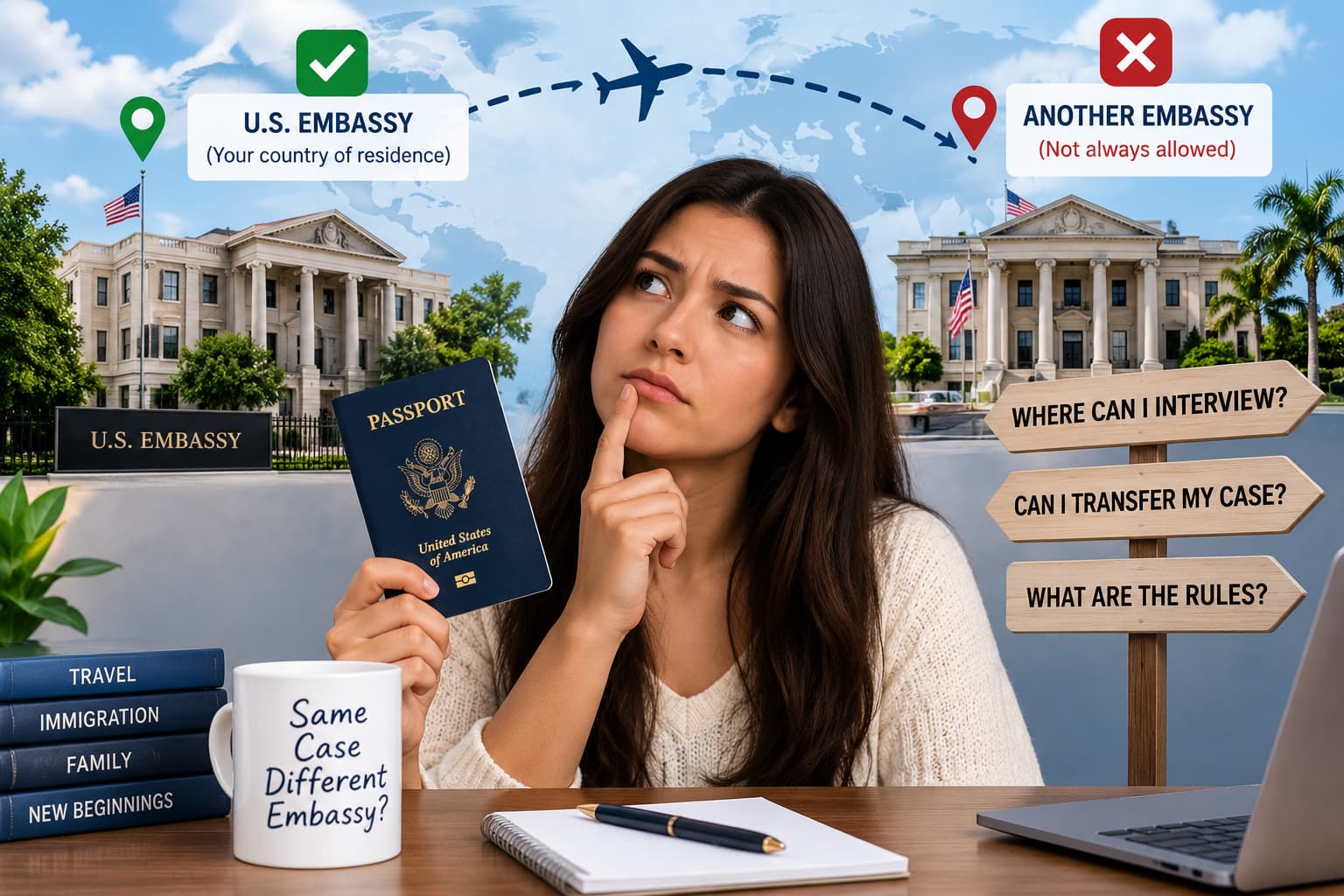
“That Embassy Is Faster” Can I Transfer My Immigration Case There?
Why “consulate shopping” is much harder under the State Department’s country-of-residence rules.
You check the NVC interview tool and discover that another U.S. embassy appears to be scheduling immigrant visa interviews much faster than the embassy handling your case. The obvious question is: “Can I just move my case there?”
Under current State Department policy, the answer is generally not as simple as choosing the shortest line.
Why did this change?
The Department of State says that, effective November 1, 2025, the National Visa Center schedules immigrant visa applicants in their country of residence or, if requested, their country of nationality. This limits the ability to transfer cases simply because another post appears faster.
Can a case still be transferred?
Transfers are still possible in appropriate circumstances, but the applicant may need to establish residence in the requested location or qualify for an exception. The Department says rare exceptions may be made for humanitarian reasons, medical emergencies or foreign-policy reasons.
Who do I contact if I want a transfer?
If NVC has already scheduled the appointment and the applicant wants a different processing post, State Department guidance says the applicant should contact NVC through the Public Inquiry Form rather than contacting the consular section directly.
What if the United States does not conduct routine visa operations in my country?
The Department assigns designated processing posts for residents of countries where routine U.S. visa operations are unavailable. Those cases follow the designated-post rules unless another permitted basis applies.
Before requesting a transfer, consider the whole case
- Whether you can prove actual residence in the requested country.
- Whether you can legally enter and remain in that country long enough for medical and consular processing.
- Whether the new post will accept the case under current State Department rules.
- Whether transferring could create additional delay instead of reducing it.
- Whether a humanitarian or medical exception is genuinely supported by evidence.
Legal disclaimer: This article is for general informational purposes only and does not constitute legal advice. Immigration rules and policies can change quickly. Eligibility and strategy depend on the facts of each individual case.

Emmanuel Gonzalez, Esq.
Latest Posts
 by Emmanuel Gonzalez, Esq.
“Esa embajada es más rápida”: ¿Puedo transferir mi caso de inmigración allí?
Por qué escoger el consulado con la fila más corta es mucho más difícil bajo las reglas actuales de residencia. Usted revisa la herramienta de entrevistas...
by Emmanuel Gonzalez, Esq.“That Embassy Is Faster” Can I Transfer My Immigration Case There?
Why “consulate shopping” is much harder under the State Department’s country-of-residence rules. You check the NVC interview tool and discover that another...