

Why Are Asylum Applications Getting Harder to Get Approved? Understanding the Rising Bar
For many people fleeing violence, persecution, and danger, asylum in the United States represents safety and hope. However, in recent years, asylum applications have become much harder to get approved, even for individuals with very real fears of returning to their home countries. Many applicants are surprised to learn that having a dangerous situation back home is no longer enough on its own.
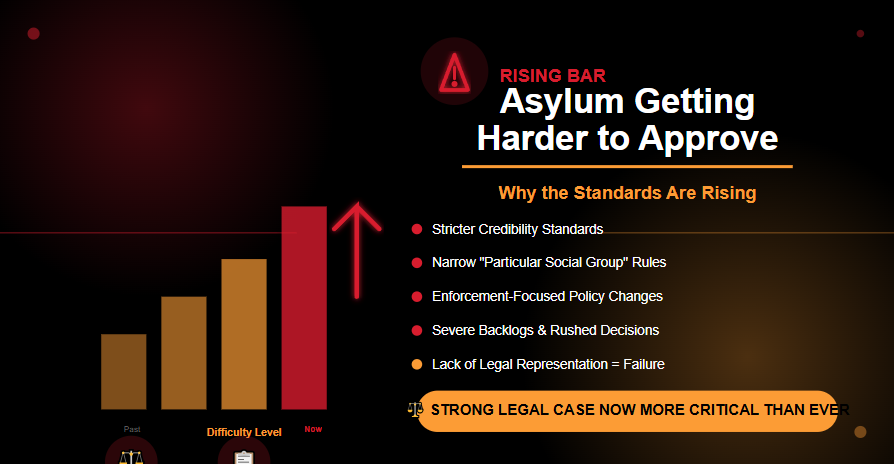
So why has asylum become more difficult? Several legal, procedural, and practical factors are working together to raise the bar.
1. Asylum Law Is Very Specific and Narrow
Asylum is not granted simply because someone comes from a dangerous country or poor conditions. Under U.S. law, an applicant must prove persecution (or a well-founded fear of persecution) based on one of five protected grounds:
- Race
- Religion
- Nationality
- Political opinion
- Membership in a particular social group
Many cases fail because, while the applicant faces real harm, the harm does not clearly fit into one of these legal categories. For example, victims of general crime, gang violence, or economic hardship often struggle to meet this strict legal standard unless the case is carefully framed and supported.
2. Higher Standards of Proof and Credibility
Immigration judges and asylum officers are applying stricter credibility standards than in the past. Applicants are expected to provide:
- Consistent testimony
- Detailed personal statements
- Supporting evidence when available
Small inconsistencies, even ones caused by trauma, fear, or language barriers, can seriously damage a case. Something as minor as a date mismatch or unclear explanation can lead to a denial if it affects credibility.
3. Increased Scrutiny of “Particular Social Group” Claims
Many asylum cases rely on the category of “membership in a particular social group.” This area of asylum law has been one of the most restricted and contested in recent years.
Courts and adjudicators now demand very specific legal elements, such as:
- Clear group definition
- Social recognition in the home country
- Evidence that persecution is because of group membership
Claims based on domestic violence, family membership, gang targeting, or gender-based harm face intense scrutiny and often require strong legal arguments and country condition evidence.
4. Policy Changes and Enforcement-Focused Approaches
Changes in immigration policy have led to a more enforcement-focused asylum system. As a result:
- Fewer cases are approved
- More applications are referred to immigration court
- Officers and judges have less discretion
Even strong cases may face longer delays, more interviews, or aggressive questioning designed to test credibility and eligibility.
5. Backlogs and Rushed Decisions
The asylum system is overwhelmed. With hundreds of thousands of pending cases:
- Officers and judges have limited time per case
- Interviews may feel rushed or intense
- Mistakes or misunderstandings are more likely
Applicants who are not well prepared may struggle to clearly explain their story under pressure.
6. Lack of Legal Representation
One of the biggest reasons asylum cases are denied is lack of legal counsel. Asylum law is one of the most complex areas of immigration law. Applicants without an attorney often:
- Do not know how to legally frame their claim
- Submit weak or incomplete evidence
- Fail to explain the connection between harm and protected grounds
Statistics consistently show that asylum seekers with legal representation are far more likely to succeed than those without.
7. Trauma Makes Telling the Story Harder
Many asylum seekers are survivors of violence, abuse, or persecution. Trauma can affect memory, communication, and emotional responses. Unfortunately, the asylum system does not always account for this reality.
Applicants may:
- Struggle to remember details
- Have difficulty speaking about painful events
- Appear nervous, inconsistent, or emotionally flat
Without proper preparation and explanation, these trauma responses can be misunderstood as dishonesty.
Practical Tips for Asylum Applicants
If you are considering applying for asylum, here are some important tips:
✅ Get legal help as early as possible. Early guidance can shape the entire case.
✅ Prepare a detailed personal statement. Your story must be clear, consistent, and legally relevant.
✅ Understand your protected ground. The reason why you were harmed matters just as much as what happened.
✅ Gather evidence when possible. Police reports, medical records, affidavits, and country condition reports can strengthen your case.
✅ Be honest and consistent. Never exaggerate or guess.
✅ Prepare for your interview or hearing. Practice answering questions clearly and calmly.
✅ Do not rely on rumors or social media advice. Each asylum case is unique.
Conclusion
Asylum applications are harder to get approved today not because people no longer need protection, but because the legal and procedural standards have become stricter and more complex. Success now requires careful preparation, strong legal framing, credible testimony, and often professional legal assistance.
While the process is challenging, asylum is still possible. A well-prepared case that clearly explains who you are, what happened to you, and why you were targeted can make all the difference.
Need Help With Your Asylum Case?
Contact an experienced immigration attorney to evaluate your claim and strengthen your application before filing.

Gonzalez Legal P.C.
Latest Posts
 by Gonzalez Legal P.C.
Why Are Asylum Applications Getting Harder to Get Approved? Understanding the Rising Bar
For many people fleeing violence, persecution, and danger, asylum in the United States represents safety and hope. However, in recent years, asylum...
by Gonzalez Legal P.C.¿Por Qué Cada Vez Es Más Difícil Que Se Aprueben las Solicitudes de Asilo? Comprendiendo el Aumento de Requisitos
Para muchas personas que huyen de la violencia, la persecución y el peligro, el asilo en Estados Unidos representa seguridad y esperanza. Sin embargo, en...