
The New Face of Expedited Removal: Understanding the Fast-Track Deportation Threat
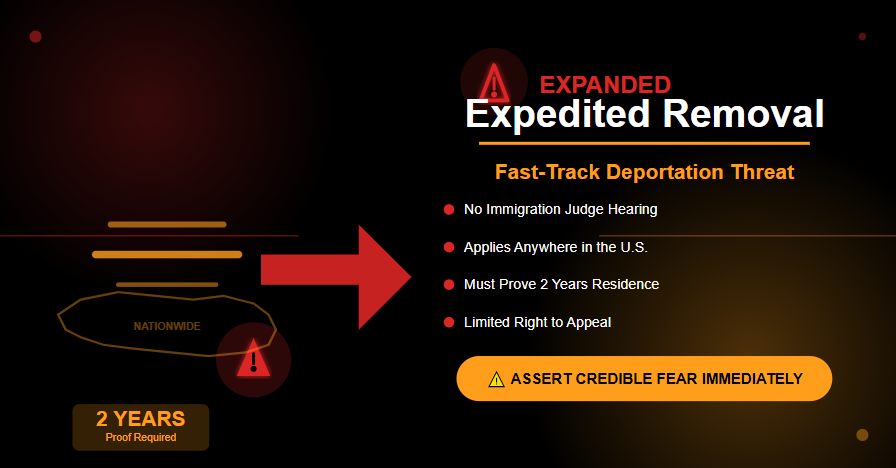
If you are an undocumented non-citizen, you are now at greater risk of being deported without ever seeing an Immigration Judge. This is due to the recent, massive expansion of a process called Expedited Removal (ER).
Historically, ER was mostly limited to people caught right at the border. Now, its reach has been stretched to cover large parts of the U.S. interior, creating a fast-track pipeline for deportation that significantly limits due process.
What is Expedited Removal (ER)?
Expedited Removal is a procedure that allows a low-level Department of Homeland Security (DHS) officer (from CBP or ICE) to order your immediate deportation without a hearing before an Immigration Judge.
It replaces the standard removal proceedings, where a judge oversees the case and you have the right to apply for relief. ER is fast, final, and has almost no ability for appeal.
How Has Expedited Removal Been Expanded?
For years, the use of ER was limited by two factors:
- Time: Applied only to people who had arrived in the U.S. within the last 14 days.
- Geography: Applied only to people encountered within 100 miles of a U.S. land border.
The new policy expansion removes these limits and pushes ER to the fullest extent allowed by law.
The new policy applies to any non-citizen who:
- Entered the U.S. without inspection (i.e., did not present themselves to an officer at a port of entry).
- Cannot prove continuous physical presence in the U.S. for at least two years immediately before the date they are encountered by DHS.
- Is encountered virtually anywhere in the United States, not just near the border.
This policy now subjects potentially hundreds of thousands of additional people to a rapid deportation process.
The Due Process Problem in Expedited Removal
The most critical difference between ER and a normal court case is the lack of due process:
| Feature | Expedited Removal (ER) | Standard Removal Proceedings |
|---|---|---|
| Hearing before a Judge | NO. Decision is made by a DHS officer. | YES. You appear before an Immigration Judge. |
| Right to an Attorney | No guaranteed right to counsel, or very limited opportunity to find one while detained. | You have the right to an attorney (at your own expense). |
| Right to Appeal | NO. The removal order is immediate and final. | YES. You can appeal the Judge’s decision to the Board of Immigration Appeals (BIA). |
| Applying for Relief | Only allowed if you pass a “credible fear” screening. | You have the right to apply for all eligible forms of relief (Cancellation of Removal, Asylum, etc.). |
The speed and lack of judicial oversight dramatically increase the risk of erroneous deportations, where individuals with valid claims to stay may be removed due to a quick administrative decision.
What About Asylum and Credible Fear?
If you are placed in Expedited Removal, you still have one crucial protection:
- Assert Your Fear: You must immediately tell the DHS officer that you are afraid to return to your country or that you intend to apply for asylum.
- Credible Fear Interview (CFI): If you assert fear, the officer must refer you to an Asylum Officer for a CFI. This interview determines if you have a “significant possibility” of establishing an asylum claim.
- Path to a Judge: If you pass the CFI, the Expedited Removal order is cancelled, and you are placed into Standard Removal Proceedings before an Immigration Judge to pursue your full asylum case.
- Deportation: If you fail the CFI, you are generally subject to immediate deportation. You have a limited, rapid review of the negative finding before an Immigration Judge (often within days), but this review is highly restricted.
What Can You Do to Protect Yourself?
Given the expanded scope of ER, here are critical steps to take:
- Be Prepared to Prove Two Years: Carry or memorize information about documents (leases, utility bills, school/church records, pay stubs) that could prove two years of continuous residency in the U.S. If you can prove two years, you cannot be subjected to ER.
- Know Your Rights: Remember your right to remain silent and refuse to sign any paperwork you don’t understand.
- Assert Fear Immediately: If you are detained and are afraid to return to your country, state clearly, “I am afraid to go back to my country,” to ensure you are referred for a Credible Fear Interview.
- Consult an Attorney: Seek legal advice now to understand your risks and prepare your family for any potential enforcement action.

Gonzalez Legal P.C.
Latest Posts
 by Gonzalez Legal P.C.
La Nueva Cara de la Deportación Acelerada: Comprender la Amenaza de Deportación Rápida
Si usted es un no ciudadano indocumentado, ahora corre un mayor riesgo de ser deportado sin ver a un juez de inmigración. Esto se debe a la reciente y...
by Gonzalez Legal P.C.The New Face of Expedited Removal: Understanding the Fast-Track Deportation Threat
If you are an undocumented non-citizen, you are now at greater risk of being deported without ever seeing an Immigration Judge. This is due to the recent,...